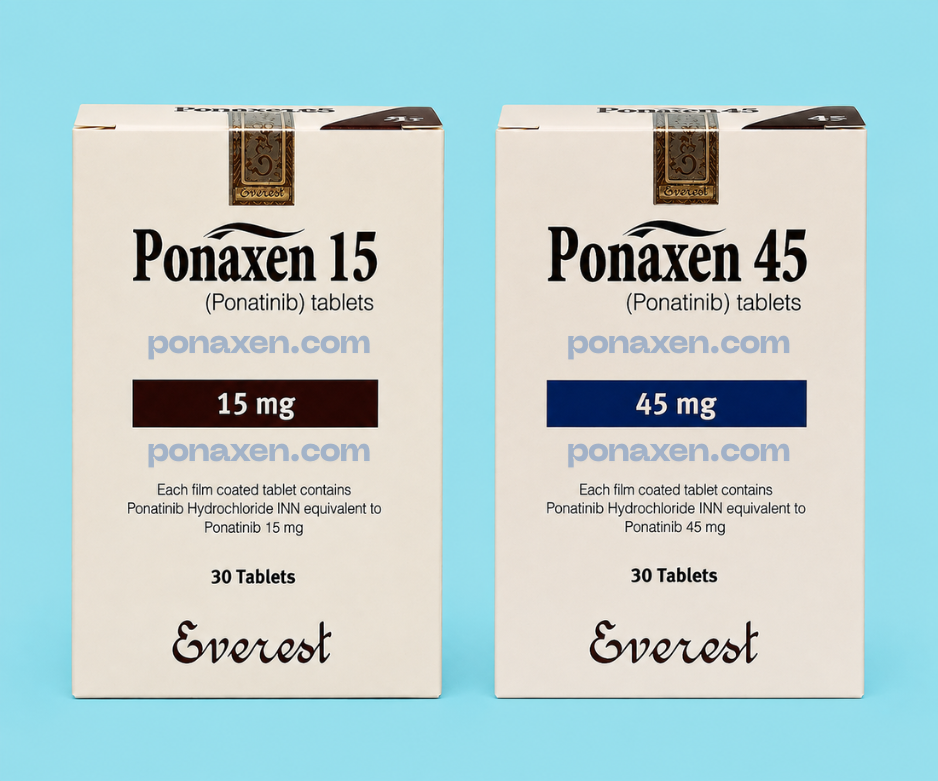
Ponaxen 15 mg & 45 mg (Ponatinib)
Disclaimer: Before purchasing any medicine, always verify whether there is a valid drug license.
Ponaxen is identified for this website as a product containing ponatinib in the stated strengths of 15 mg and 45 mg. Product-specific information—including the manufacturer, marketing authorization holder, manufacturing site, formulation, packaging, country of authorization and regulatory status—should be verified against the actual product packaging and applicable official regulatory documentation before publication.
Ponatinib is an orally administered tyrosine kinase inhibitor (TKI) used in selected hematologic malignancies, particularly chronic myeloid leukemia (CML) and Philadelphia chromosome-positive acute lymphoblastic leukemia (Ph+ ALL). Ponatinib was specifically designed to inhibit the BCR::ABL1 tyrosine kinase, including treatment-resistant BCR::ABL1 mutations such as T315I. Takeda describes ICLUSIG as having been developed using ARIAD’s computational and structure-based drug-design platform.
The established reference product is ICLUSIG, the ponatinib-containing product originally developed by ARIAD Pharmaceuticals, Inc. ICLUSIG received its initial U.S. approval in December 2012.
ARIAD was subsequently acquired by Takeda Pharmaceutical Company Limited in 2017, bringing ICLUSIG into Takeda’s oncology portfolio.
Everest Pharmaceuticals Ltd. About the Manufacturer
Everest Pharmaceuticals Ltd. is a pharmaceutical manufacturer based in Bangladesh. The company is involved in the development, production, and marketing of pharmaceutical products, including medicines used in specialized therapeutic areas.
Everest Pharmaceuticals focuses on manufacturing quality medicines for the healthcare market and offers a range of products, including treatments used in oncology and other medical fields. Its product portfolio includes various generic medicines formulated for patients and healthcare providers.
Company Name: Everest Pharmaceuticals Ltd.
Industry: Pharmaceutical Manufacturing
Country: Bangladesh
Business Activities: Manufacturing, marketing, and distribution of pharmaceutical products
Product Areas: Includes specialized and general pharmaceutical medicines
Quality Focus: Product manufacturing and quality-control processes are intended to support medicine quality, safety, and regulatory compliance.
For product-specific information, it is important to check the official packaging, product insert, batch details, and manufacturer information, as formulations and regulatory status may vary by product and market.
Head Office: Everest Pharmaceuticals Ltd. is located at Rahman’s Regnum Centre (10th & 11th floor), 191/1 Tejgaon Commercial Area, Dhaka-1208, Bangladesh.
Manufacturing Plant: Everest Pharmaceuticals Limited B-33, 45 & 46, BSCIC, Kanchpur, Narayanganj–1430, Bangladesh.
| Topic | Information |
|---|---|
| Product name | Ponaxen |
| Active ingredient | Ponatinib |
| Stated strengths | 15 mg and 45 mg |
| Therapeutic class | Tyrosine kinase inhibitor |
| Primary molecular target | BCR::ABL1 |
| Therapeutic area | Hematologic malignancies |
| Reference product | ICLUSIG |
| Original developer | ARIAD Pharmaceuticals, Inc. |
| Original reference-product manufacturer | ARIAD Pharmaceuticals, Inc. |
| Current ICLUSIG company | Takeda Pharmaceutical Company Limited |
| Ponaxen manufacturer | Everest Pharmaceuticals Ltd. |
| Marketing authorization holder | Everest Pharmaceuticals Ltd. |
| Ponaxen regulatory status | Leukemia |
What Is Ponatinib?
Ponatinib is a targeted anticancer medicine belonging to the tyrosine kinase inhibitor class. Its principal pharmacologic target is BCR::ABL1, the abnormal tyrosine kinase associated with CML and Ph+ ALL.
Ponatinib was designed to inhibit BCR::ABL1 as well as BCR::ABL1 variants that can confer resistance to earlier tyrosine kinase inhibitors. Of particular importance is the T315I mutation, which has historically been associated with resistance to multiple other BCR::ABL1-targeted therapies.
Originator, Reference Product and Development History
The development history of ponatinib is important when describing a product such as Ponaxen.
ARIAD Pharmaceuticals, Inc. discovered and developed ponatinib and developed the reference product ICLUSIG. The original U.S. ICLUSIG labeling identified ARIAD Pharmaceuticals as the company for which the product was manufactured.
The U.S. FDA approved ICLUSIG on December 14, 2012 for specified patients with CML and Ph+ ALL.
In January 2017, Takeda announced its agreement to acquire ARIAD Pharmaceuticals. The transaction included ICLUSIG and strengthened Takeda’s hematology and oncology portfolio.
Therefore, the development history can be summarized as:
Ponatinib → developed by ARIAD Pharmaceuticals → ICLUSIG reference product → ARIAD acquired by Takeda → ICLUSIG subsequently associated with Takeda.
This history should not be interpreted as evidence that Ponaxen is manufactured by Takeda or ARIAD. The manufacturer of Ponaxen itself remains unverified from the supplied product information.
Ponaxen Compared With ICLUSIG
Ponaxen should not automatically be described as identical to ICLUSIG merely because both products contain ponatinib.
Two products containing the same active pharmaceutical ingredient may differ in:
-
Manufacturer
-
Marketing authorization holder
-
Manufacturing site
-
Excipients
-
Tablet formulation
-
Packaging
-
Batch-release arrangements
-
Regulatory authorization
-
Country of sale
-
Supply chain
-
Approved indications
Accordingly, Ponaxen should be described as a ponatinib-containing product, while ICLUSIG should be identified separately as the established reference product unless official documentation demonstrates a specific regulatory relationship.
Available Strengths
The supplied product information identifies Ponaxen in:
-
15 mg
-
45 mg
These strengths are also established strengths of ICLUSIG. FDA labeling has identified ICLUSIG tablets in 15 mg, 30 mg and 45 mg strengths.
The existence of the same strengths in the reference product does not, by itself, establish that Ponaxen has the same formulation, excipients, manufacturing process or regulatory authorization.
How Ponatinib Works
Ponatinib inhibits the abnormal BCR::ABL1 tyrosine kinase. BCR::ABL1 is produced by the Philadelphia chromosome-associated genetic abnormality and drives signaling that promotes abnormal proliferation and survival of leukemic cells.
Ponatinib was designed to inhibit both native BCR::ABL1 and resistant forms of the kinase, including the clinically important T315I mutation.
In simple terms, ponatinib blocks an abnormal molecular signal that helps certain leukemia cells survive and multiply.
Its activity against resistant BCR::ABL1 variants is one of the defining characteristics of ponatinib and an important reason for its use in selected patients with difficult-to-treat CML or Ph+ ALL.
What Is Ponatinib Used For?
Ponatinib’s approved indications depend on the country and the current regulatory label.
Historically, U.S. ICLUSIG labeling included treatment of adults with chronic-phase, accelerated-phase or blast-phase CML or Ph+ ALL in situations where other TKI therapy was not indicated, as well as patients with T315I-positive CML or Ph+ ALL.
The U.S. indication has subsequently evolved. In March 2024, the FDA granted accelerated approval for ponatinib with chemotherapy for adults with newly diagnosed Ph+ ALL.
Because indications and treatment regimens can change, the current local prescribing information should always be consulted rather than assuming that an indication approved in one country applies to Ponaxen everywhere.
Chronic Myeloid Leukemia (CML)
CML is a hematologic malignancy characterized by abnormal proliferation of myeloid cells and is commonly associated with the BCR::ABL1 fusion protein.
Ponatinib may have an important role in selected CML patients, particularly where resistance or intolerance to previous tyrosine kinase inhibitor therapy creates a need for another BCR::ABL1-targeted treatment.
The specific treatment line, dose and eligibility criteria depend on the applicable regulatory label and the patient’s clinical circumstances.
Philadelphia Chromosome-Positive Acute Lymphoblastic Leukemia
Ph+ ALL is a subtype of acute lymphoblastic leukemia characterized by the Philadelphia chromosome and resulting BCR::ABL1 activity.
Ponatinib has been used in selected adults with Ph+ ALL. In the United States, the FDA granted accelerated approval in 2024 for ponatinib in combination with chemotherapy for adults with newly diagnosed Ph+ ALL.
Other regulatory jurisdictions may use different indications, combinations or eligibility criteria.
T315I Mutation
The T315I BCR::ABL1 mutation is particularly important in the history of ponatinib.
This mutation can reduce the effectiveness of several earlier BCR::ABL1 tyrosine kinase inhibitors. Ponatinib was specifically designed to retain activity against resistant BCR::ABL1 mutations, including T315I.
The presence or absence of T315I is only one factor in determining treatment. Ponatinib should not be selected solely on the basis of information presented on this website.
Dosage and Administration
Ponatinib dosing is indication-specific and can change according to treatment response, adverse reactions, concomitant medicines, organ function and the applicable regulatory label.
Historical U.S. ICLUSIG labeling included a 45 mg once-daily regimen and dose modifications for toxicity.
However, current treatment strategies can use different starting doses and response-based approaches depending on the indication. For example, Takeda reported FDA approval of a response-based dosing regimen for resistant or intolerant chronic-phase CML in 2020.
Therefore, a fixed dose should not be presented as an individualized recommendation for Ponaxen.
Patients should:
-
Take ponatinib exactly as prescribed.
-
Follow the dosing schedule supplied by their healthcare professional.
-
Not change the dose independently.
-
Not stop treatment without medical guidance.
-
Follow the specific instructions accompanying their product.
Administration With Food
Historical ICLUSIG prescribing information states that the tablets may be taken with or without food.
For Ponaxen specifically, administration instructions should be confirmed against the product’s own official prescribing information where available.
Missed Dose
Patients should follow the missed-dose instructions supplied with their specific prescription and product documentation.
A missed dose should not be compensated for by taking additional tablets unless specifically instructed by the treating healthcare professional.
Major Safety Warning
Ponatinib has a particularly important safety profile.
The U.S. ICLUSIG prescribing information carries a boxed warning addressing:
-
Arterial occlusive events
-
Venous thromboembolic events
-
Heart failure
-
Hepatotoxicity
Arterial occlusive events have included serious and sometimes fatal cardiovascular and cerebrovascular events. Venous thromboembolic events and heart failure have also occurred, including fatal cases, while hepatotoxicity and liver failure have been reported.
Because of these risks, ponatinib treatment requires careful patient selection, monitoring and management by an appropriately qualified healthcare professional.
Important Adverse Reactions and Risks
Important warnings and precautions associated with ponatinib include:
Arterial Occlusive Events
Arterial occlusion can affect coronary, cerebral and peripheral arteries and can result in myocardial infarction, stroke, severe peripheral vascular disease or other serious complications.
Venous Thromboembolism
Venous thromboembolic events can occur during treatment and may require treatment interruption, modification or discontinuation depending on severity.
Heart Failure
Heart failure, including serious and fatal cases, has been reported. Cardiac function and symptoms should be monitored according to the applicable prescribing information.
Hepatotoxicity
Ponatinib can cause liver injury, including severe hepatotoxicity and liver failure. Hepatic function should be monitored according to the applicable prescribing information.
Hypertension
High blood pressure is an important recognized adverse effect and may require clinical management or modification of treatment.
Pancreatitis
Pancreatitis and elevations in pancreatic enzymes can occur. Clinical monitoring may include serum lipase according to the prescribing information.
Neuropathy
Peripheral and cranial neuropathies have been reported. New or worsening neurologic symptoms should be medically assessed.
Ocular Toxicity
Ocular adverse reactions can occur. The prescribing information recommends appropriate ophthalmologic assessment during treatment.
Hemorrhage
Serious or severe bleeding has been reported and may require interruption or discontinuation of treatment.
Fluid Retention
Patients may develop fluid retention, which can manifest as swelling, weight gain or shortness of breath.
Cardiac Arrhythmias
Ponatinib can be associated with cardiac rhythm abnormalities and requires appropriate clinical monitoring.
Myelosuppression
Thrombocytopenia, neutropenia and anemia may occur. Blood counts should be monitored during treatment.
Tumor Lysis Syndrome
Rapid tumor-cell destruction can cause tumor lysis syndrome, particularly in patients with a high tumor burden. Appropriate preventive measures and monitoring may be required.
Reversible Posterior Leukoencephalopathy Syndrome
A rare neurologic condition known as reversible posterior leukoencephalopathy syndrome may occur. Symptoms such as seizures, confusion, visual disturbances or other acute neurologic changes require urgent medical evaluation.
Impaired Wound Healing and Gastrointestinal Perforation
Ponatinib can impair wound healing and has been associated with gastrointestinal perforation. Treatment around planned surgery should be managed by the treating clinical team.
Embryo-Fetal Toxicity
Ponatinib can cause fetal harm. Pregnancy and reproductive considerations should be discussed with a healthcare professional before treatment.
Commonly Reported Adverse Reactions
The adverse reactions reported with ICLUSIG vary according to the study population, dose and treatment setting.
Reported reactions have included:
-
Abdominal pain
-
Rash
-
Constipation
-
Headache
-
Dry skin
-
Fatigue
-
Hypertension
-
Fever
-
Joint pain
-
Nausea
-
Diarrhea
-
Vomiting
-
Muscle pain
-
Pain in an extremity
-
Increased lipase
-
Arterial occlusive events
The frequency of individual reactions should be interpreted according to the specific clinical indication and current prescribing information.
Drug Interactions
Ponatinib exposure can be affected by other medicines.
The ICLUSIG prescribing information identifies clinically important interactions involving strong CYP3A inhibitors and strong CYP3A inducers. Strong CYP3A inducers should generally be avoided, while dose adjustment may be required when strong CYP3A inhibition cannot be avoided.
Patients should provide their healthcare professional with a complete list of prescription medicines, nonprescription medicines, supplements and herbal products before starting treatment.
Pregnancy and Breastfeeding
Ponatinib can cause embryo-fetal toxicity and may harm a developing fetus. Appropriate pregnancy-prevention measures should be discussed with the treating healthcare professional.
The U.S. ICLUSIG labeling advises against breastfeeding during treatment.
Monitoring During Treatment
Depending on the indication and clinical circumstances, monitoring may include:
-
Blood pressure
-
Complete blood counts
-
Liver function
-
Pancreatic enzymes
-
Cardiovascular status
-
Symptoms of arterial or venous thrombosis
-
Cardiac rhythm
-
Neurologic symptoms
-
Ocular symptoms
-
Fluid retention
-
Signs of bleeding
-
Tumor lysis syndrome risk
The exact monitoring program should be determined by the treating healthcare professional according to the applicable prescribing information.
Everest Pharmaceuticals Ltd. Product Verification Process
To verify the authenticity of an Everest Pharmaceuticals product, follow the verification process below:
Scan the QR Code: Scan the QR code printed on the product box.
The QR code will direct you to the official product verification page.
Open the Box: After accessing the verification page, open the product box and locate the verification code printed on the bottle.
Submit the Verification Code: Enter the verification code from the bottle on the verification page and submit it to check the product’s authenticity.
Verification Success: If the verification is successful, the product is confirmed as legitimate.
Verification Error: If the system displays a verification error, the product may be counterfeit or unauthorized. Do not use the product until its authenticity has been confirmed through an appropriate official channel.
Counterfeit Products: If a product is confirmed to be fake, do not use or distribute it. Report the suspected counterfeit product and supplier to the appropriate regulatory authorities, such as the Directorate General of Drug Administration (DGDA) in World, and take appropriate legal action against the supplier through the relevant authorities.
Important: Always purchase medicines from licensed pharmacies or authorized suppliers and verify suspicious products before use.
Medical Disclaimer
Ponaxen and ponatinib are prescription oncology medicines. The information on this website is provided for general educational purposes and should not be used as a substitute for professional medical advice, diagnosis or treatment.
Do not start, stop, increase or decrease ponatinib based solely on information presented on this website.
Treatment decisions should be made by an appropriately qualified healthcare professional using the patient’s diagnosis, mutation status, previous treatment history, organ function, concomitant medicines and the latest applicable prescribing information.
Approved indications, dosing recommendations, warnings and regulatory requirements may differ between countries and may change over time.
Frequently Asked Questions
What is Ponaxen?
Ponaxen is identified on this website as a product containing ponatinib in stated 15 mg and 45 mg strengths. Product-specific manufacturer and regulatory information requires verification.
What is ponatinib?
Ponatinib is an oral tyrosine kinase inhibitor that targets BCR::ABL1 and is used in selected patients with CML and Ph+ ALL.
What is the reference product for ponatinib?
The established reference product is ICLUSIG, originally developed by ARIAD Pharmaceuticals.
Who originally developed ponatinib?
Ponatinib and ICLUSIG were developed by ARIAD Pharmaceuticals, Inc.
Who currently owns ICLUSIG?
Takeda acquired ARIAD Pharmaceuticals in 2017, including ICLUSIG in the transaction.
Is Ponaxen the same as ICLUSIG?
Not necessarily. Both may contain ponatinib, but product identity, manufacturer, formulation, excipients, authorization and packaging can differ.
What strengths of Ponaxen are listed?
The supplied product information identifies 15 mg and 45 mg strengths.
What is ponatinib used for?
Ponatinib is used in selected CML and Ph+ ALL treatment settings. Current approved indications and combinations vary by jurisdiction. The U.S. FDA also granted accelerated approval in 2024 for ponatinib with chemotherapy in adults with newly diagnosed Ph+ ALL.
Does ponatinib work against T315I?
Ponatinib was specifically designed to inhibit BCR::ABL1 and resistant mutations including T315I.
What are the most serious risks of ponatinib?
Important risks include arterial occlusive events, venous thromboembolism, heart failure and hepatotoxicity. Other serious risks include hypertension, pancreatitis, neuropathy, ocular toxicity, hemorrhage, myelosuppression and impaired wound healing.
Can ponatinib cause blood clots?
Yes. Both arterial occlusive events and venous thromboembolic events are recognized serious risks.
Can ponatinib cause liver problems?
Yes. Hepatotoxicity, including severe liver injury and liver failure, is an important safety concern.
Can ponatinib be taken during pregnancy?
Ponatinib can cause fetal harm and requires appropriate pregnancy-related precautions.
Can I use Ponaxen without medical supervision?
No. Ponatinib is a potent prescription anticancer medicine with potentially life-threatening adverse effects and requires appropriate professional supervision.
References
-
U.S. Food and Drug Administration — ICLUSIG (ponatinib) prescribing information.
-
U.S. FDA — Ponatinib accelerated approval for newly diagnosed Ph+ ALL.
-
FDA Orphan Drug database — ponatinib/ICLUSIG approval history.
-
Takeda — acquisition of ARIAD Pharmaceuticals and ICLUSIG development history.
-
Original FDA ICLUSIG labeling identifying ARIAD Pharmaceuticals.
Editorial note: The supplied source material supports the identification of Ponaxen as a stated 15 mg and 45 mg ponatinib product, but does not establish its manufacturer, marketing authorization holder or regulatory status. Those fields should remain explicitly marked for verification rather than being inferred from the history of ICLUSIG. The broader website content should likewise distinguish clearly between Ponaxen-specific facts and reference-product information.
Daniel M.
Ponaxen information is presented clearly and professionally. I found the details about ponatinib, its uses, strengths, and safety considerations easy to understand.
Sarah K.
The Ponaxen FAQ section is very helpful. It explains important topics such as T315I, dosing, monitoring, and possible risks in a simple and understandable way.
Michael R.
A useful resource for learning about Ponaxen and ponatinib. The information about how the medicine works and why medical supervision is important was especially helpful.
Latest News
Hello world!
August 18, 2026 | by ponaxen
Welcome to WordPress. This is your first post. Edit or delete it, then start writing!
Read More →
FAQs
Ponaxen is identified as a ponatinib-containing product. Ponatinib belongs to a class of targeted medicines called tyrosine kinase inhibitors, which act on specific signaling proteins involved in cancer-cell growth.
BCR::ABL1 is an abnormal tyrosine kinase associated with Philadelphia chromosome-positive leukemias. Ponatinib targets BCR::ABL1 and can interfere with signaling that supports abnormal leukemia-cell growth.
Ponatinib may be used in selected patients whose disease is resistant or intolerant to previous kinase inhibitors. Its activity against certain resistant BCR::ABL1 mutations, including T315I, is an important part of its clinical role.
Yes. Ponatinib dosing may be adjusted according to the treatment indication, response to therapy, adverse reactions, liver function, drug interactions and other clinical factors. Dose changes should only be made by the treating healthcare professional.
Monitoring may include blood pressure, blood counts, liver function and pancreatic enzymes. Depending on the patient’s treatment and risk factors, healthcare professionals may also assess cardiovascular, vascular, neurological or eye-related symptoms.
Yes. Ponatinib can interact with certain medicines, including drugs that affect CYP3A activity. Patients should tell their healthcare professional about all prescription medicines, over-the-counter products and supplements they use.
Current U.S. ICLUSIG labeling instructs patients to swallow the tablets whole. Tablets should not be crushed, broken, cut or chewed unless specifically directed by a healthcare professional.
Yes. Ponatinib can cause myelosuppression, including reductions in certain blood-cell counts. Blood tests may therefore be performed regularly during treatment to monitor for these changes.
Yes. Pancreatitis and elevations in pancreatic enzymes such as lipase have been reported with ponatinib. Appropriate laboratory monitoring and medical evaluation may be required during treatment.
Ponaxen contains ponatinib, which has potentially serious cardiovascular, vascular, hepatic and other risks. Appropriate prescribing, dose selection and regular monitoring help healthcare professionals manage treatment safely.